



5 Relaxing Postures That Are Terrible for Your Lower Back!
Some relaxing postures may seem harmless, but maintaining them for too long can put extra strain on your lower back. Learn about these five common postures and how to correct them.
-
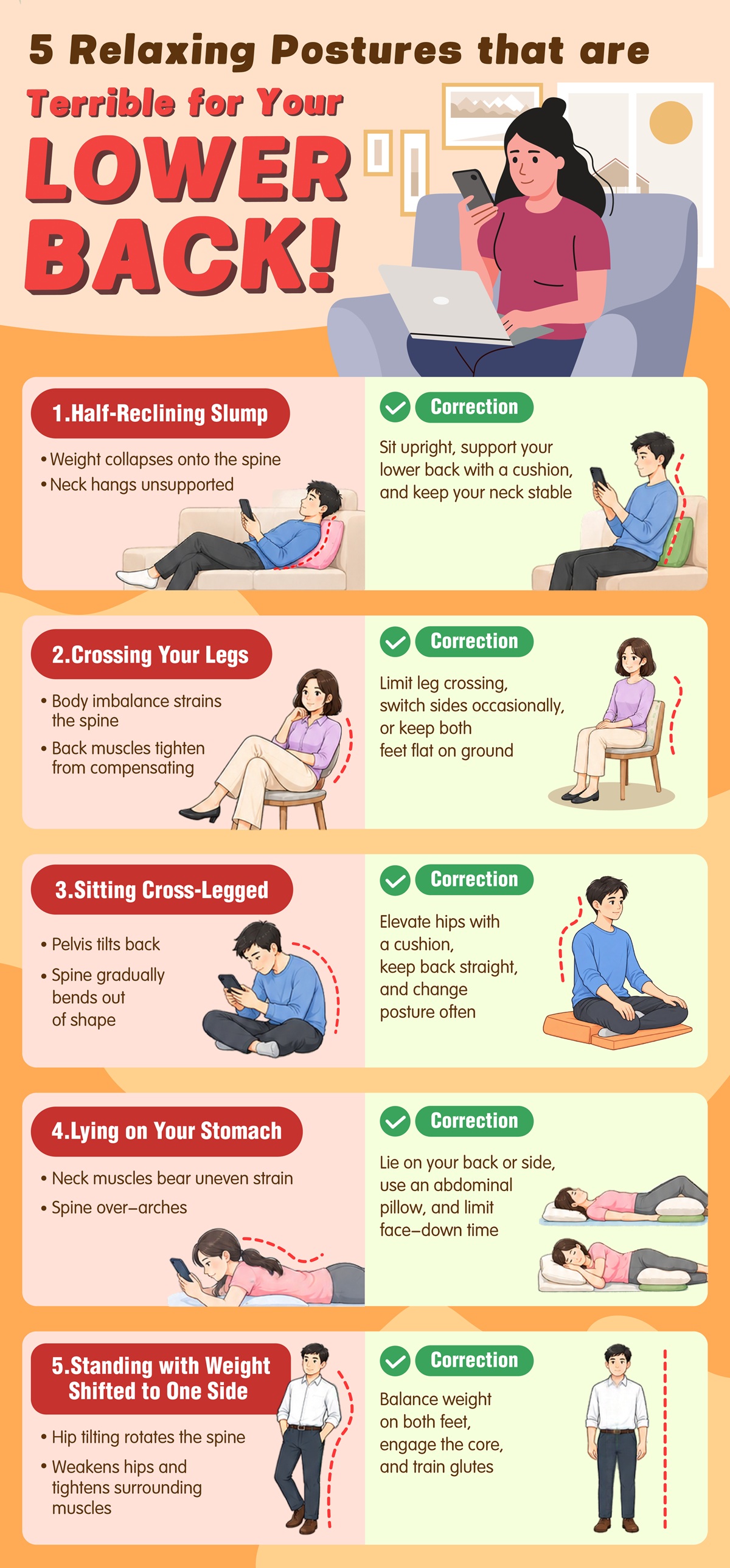
Half-Reclining Slump
Commonly known as the “Ge You slouch,” this seemingly relaxing posture can cause unnoticed strain to build up in the lower back when maintained for too long. This is because the weight of the upper body presses down on the spine, while the cervical spine and back remain unsupported and bent.
Correction: Sit upright against the backrest, place a cushion behind your lower back, and ensure your neck has stable support.
-
Crossing Your Legs
Crossing the legs is often seen as an elegant or confident posture. However, once it becomes a habit, the body remains in an imbalanced position for long periods, placing extra pressure on the spine. The lower back muscles may also become tight and sore as they compensate for the imbalance.
Correction: Avoid crossing your legs for long periods, switch sides often, or keep both feet flat on the floor.
-
Sitting Cross-Legged
This sitting posture is often developed from childhood. If posture is not properly maintained while sitting cross-legged, the upper body may lean forward or to one side. Combined with the pelvis tilting backward, this can eventually lead to spinal curvature and misalignment.
Correction: Place a cushion under the hips to elevate the pelvis, keep the back straight, and change posture regularly.
-
Lying on Your Stomach
Although lying face down may feel relieving, staying in this position for too long causes the neck to remain at an extreme rotated angle, resulting in uneven muscle strain on both sides of the neck. At the same time, the spine may sink excessively toward the abdomen, causing excessive bending of the lumbar spine.
Correction: Switch to lying on your back or side, place a pillow under the abdomen to reduce pressure, and shorten the time spent lying face down.
-
Standing with Weight Shifted to One Side
This refers to a standing posture where the hips shift to one side, causing rotation in the lumbar and thoracic spine. Over time, the hip muscles may weaken, while other muscles become tight from overcompensating.
Correction: Distribute weight evenly on both feet, engage the core, and include glute muscle training.
 |
 |
|---|